Activated carbon for mercury removal
Mercury is a highly toxic heavy metal that represents a serious threat to human health and the environment. It is widely present in various industrial activities, such as mining, power generation and chemical manufacturing.
Activated carbon, thanks to its outstanding adsorption capacity, has become an effective solution for the removal of mercury. This article explores in depth the role of activated carbon in mercury removal, its characteristics, and how to choose the right product to meet different industrial needs.
The problem of industrial mercury pollution
Mercury pollution comes mainly from industrial activities such as coal burning, mining, and chemical production. Mercury easily accumulates in the environment, affecting ecosystems and human health, especially with serious consequences for the nervous system.
Sources of mercury pollution
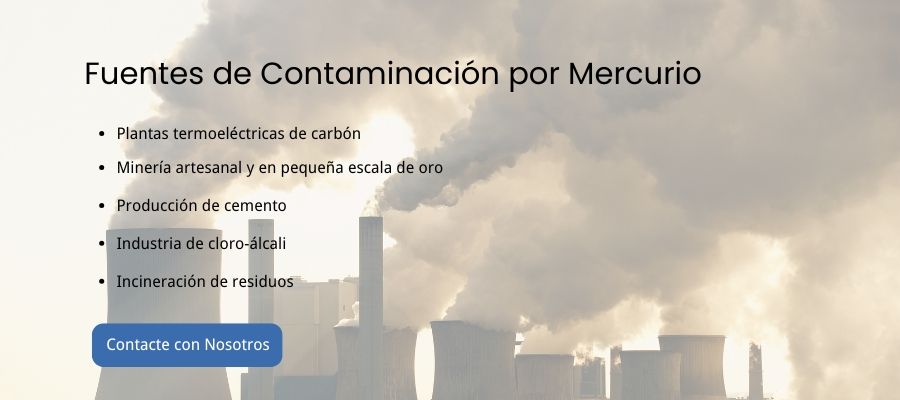
Mercury enters the environment primarily through human activities. Major industrial sources include:
- Coal-fired thermoelectric plants: Responsible for approximately 45% of human mercury emissions into the atmosphere.
- Artisanal and small-scale gold mining: It uses mercury to separate gold from other minerals, which significantly increases mercury emissions.
- Cement production: The mercury present in the raw materials volatilizes during the calcination process.
- Chlor-alkali industry: Although their use has decreased, factories that use mercury cells remain an important source.
- Waste incineration: Burning discarded products that contain mercury (such as thermometers, batteries, or fluorescent lamps) releases mercury into the environment.
These emissions not only pollute the air, but eventually settle in the soil and bodies of water, starting a cycle of pollution that affects ecosystems and human health.
Impacts on the environment and health
Mercury is a potent neurotoxin that can cause irreversible damage to the nervous system, especially during fetal development and infancy. Exposure to this metal can cause:
- Permanent neurological damage
- Impaired cognitive function
- Kidney and cardiovascular problems
- Reproductive disorders
- Immune system dysfunctions
In the environment, mercury can be transformed into methylmercury, a highly toxic organic form that accumulates in aquatic organisms and is magnified through the food chain. This capacity for persistence and concentration means that even small emissions have significant long-term risks.
Basic principles of activated carbon in mercury capture
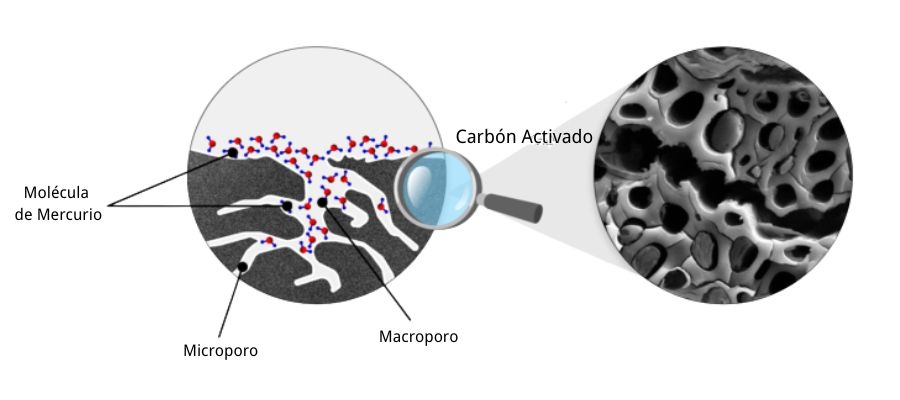
Activated carbon is a highly efficient adsorption material, with an extremely large specific surface area and a rich pore structure that allows it to adsorb multiple contaminants. The working principles of activated carbon to remove mercury include:
- Physical adsorption: The microporous structure of activated carbon captures mercury molecules through Van der Waals forces, fixing them firmly in its pores.
- Chemical adsorption: Some activated carbons are infused with chemicals such as sulfur, which chemically react with mercury to form stable compounds, improving removal efficiency.
- High adsorption capacity: The special structure of activated carbon allows it to remove mercury even in low concentration environments.
These characteristics make activated carbon the ideal choice for treating industrial waste gases (such as those emitted by coal plants) and industrial waste liquids (such as those from chemical production).
Applications of activated carbon in the elimination of mercury
Thanks to its efficient and versatile adsorption capacity, activated carbon is widely used in various industrial sectors for mercury removal. The main application scenarios are described below:
Combustion gas treatment in thermoelectric plants

Coal-fired thermoelectric plants are one of the main sources of mercury emissions. During coal combustion, mercury is released in gaseous form into the flue gas stream. If left unchecked, this mercury is released directly into the atmosphere through smokestacks. Activated carbon can efficiently remove mercury from flue gases:
- Activated carbon injection (ACI) technology: It consists of injecting powdered activated carbon directly into the flue gas flow, quickly capturing gaseous mercury.
- Excellent high temperature performance: Activated carbon maintains its adsorption capacity even under high temperature conditions.
Treatment of waste gases and liquids in the chemical industry

In chemical production (such as in the chlor-alkali industry or metal refining), mercury can appear as a byproduct or contaminant. Applications of activated carbon in the chemical industry include:
- Waste gas purification: Use of granular or sulfur-impregnated activated carbon to remove gaseous mercury from production processes.
- Waste liquid treatment: Activated carbon can adsorb mercury ions in waste liquids, ensuring that the discharged water meets environmental regulations.
Incineration of medical waste
Incineration of medical waste can release contaminants containing mercury, especially from devices containing this metal (such as thermometers). Activated carbon is used to remove mercury from the flue gases generated in this process.
Mercury control in the petrochemical industry
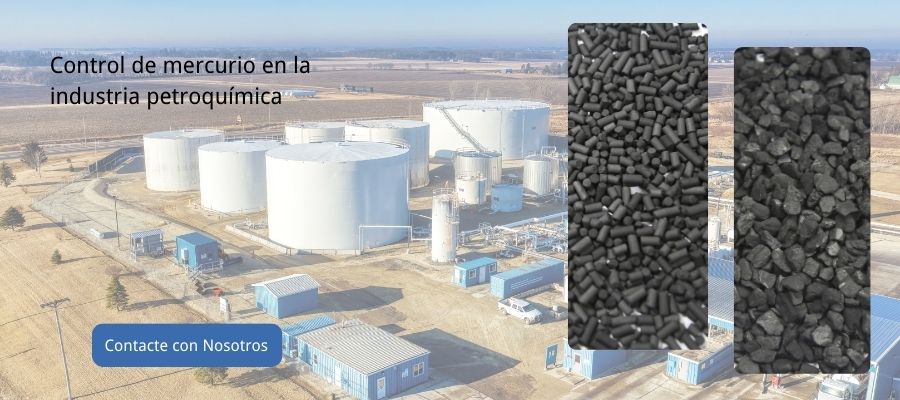
During the extraction and processing of oil and natural gas, mercury may be present as an impurity, especially in natural gas. Activated carbon can be used for:
- Natural gas purification: Eliminate gaseous mercury, protecting downstream equipment (such as heat exchangers and catalysts) from mercury corrosion.
- Removal of mercury in liquids: Adsorb mercury in liquid hydrocarbons, ensuring product purity and equipment safety.
Types of activated carbon for mercury removal
Selection of the appropriate activated carbon depends on the use scenario, the form in which the mercury is present, and the treatment requirements. We mainly offer the following types of activated carbon:
Sulfur-impregnated activated carbon

Sulfur-impregnated activated carbon
Highly effective mercury removal, available in large quantities and a wide range of sizes. Factory quote, fast delivery.
During the production process, chemicals such as sulfur are impregnated into the pores of the activated carbon, which improves its chemical adsorption capacity and makes it ideal for mercury removal. Specific types include:
Granular activated carbon
This type of sulfur-impregnated activated carbon chemically reacts with mercury to form mercury sulfide, a non-volatile compound, thus improving its adsorption capacity.
- Advantages: High adsorption capacity and efficiency in removing mercury. Its granular structure makes it ideal for fixed bed systems, with low pressure drop and long useful life.
- Application scenarios: Widely used in oil and gas industries, as well as industrial waste gas purification.
Pelletized Activated Carbon
Manufactured from high quality carbon and with a special process, this type of carbon has a developed pore structure and high mechanical strength. After sulfur treatment, its performance in mercury adsorption is further improved.
- Advantages: High mercury adsorption capacity, low pressure drop and less dust generation.
- Application scenarios: Suitable for gas treatment, removing mercury from industrial gases such as natural gas or air.
Powdered activated carbon

Powdered Activated Carbon
Rapid mercury removal capacity, effective adsorption. Mass production, favorable price and guaranteed quality.
Powdered activated carbon is produced by grinding activated carbon into fine particles. Due to its small particle size, it has a large specific surface area and high adsorption rate, making it ideal for the removal of mercury from liquid media. Where necessary, powder-impregnated activated carbon (such as with sulfur) can be used to improve mercury removal.
Features:
- Large number of high energy pores
- Excellent transport pore structure
- Exceptional fluidity and low content of volatile compounds
- High adsorption capacity for mercury and other contaminants
- Fast adsorption kinetics, with minimal contact times
Application scenarios:
Mainly used in coal plants, waste incinerators and industrial wastewater treatment where rapid removal of mercury in flue gases is needed.
Conclusion
Mercury removal is a complex but crucial process, and activated carbon, thanks to its outstanding adsorption performance, has become the preferred solution for multiple industrial applications.
If you are looking for a reliable activated carbon supplier or want to get a customized quote, please feel free to contact us at. We specialize in offering solutions tailored to the needs of our clients, helping them efficiently address mercury pollution problems.