Activated Carbon: An Effective Solution to Recover Gold
Gold, due to its rarity and value, is widely used in both investment and industrial applications. With the development of extraction technologies, the activated carbon adsorption method has become an efficient and economical standard process in the field of gold recovery, standing out especially in the CIP (carbon in pulp) and CIL (carbon in leach) processes.
This article presents in detail the use of activated carbon in Gold Recovery, including its advantages, processes and the most common product types, to help you achieve a higher gold recovery rate and better economic benefits in industrial practice.
Why is activated carbon ideal for gold recovery?

Activated carbon has unique characteristics that make it the preferred material for gold recovery in modern mining. Its highly porous structure provides a large internal surface area, creating an ideal environment for the adsorption of gold-cyanide complexes present in leach solutions.
When gold is dissolved in a cyanide solution, it forms anionic complexes (Au(CN)₂⁻), which are strongly attracted to the active sites on the surface of the activated carbon. This adsorption process is highly selective, meaning that the activated carbon has a greater affinity for gold complexes than for other ions present in the solution, thus achieving specific and efficient recovery.
In addition, activated carbon offers important operational advantages:
- Resistance to extreme conditions- Works effectively in various chemical environments and temperatures.
- Regenerability: After gold desorption, the carbon can be thermally reactivated and reused multiple times.
- Easy to operate: Activated carbon-based systems are relatively simple to implement and operate, even in remote locations.
- Profitability- Allows gold to be recovered profitably even from low-grade ores.
These characteristics make activated carbon an indispensable component in modern gold extraction and recovery.
Gold recovery processes with activated carbon
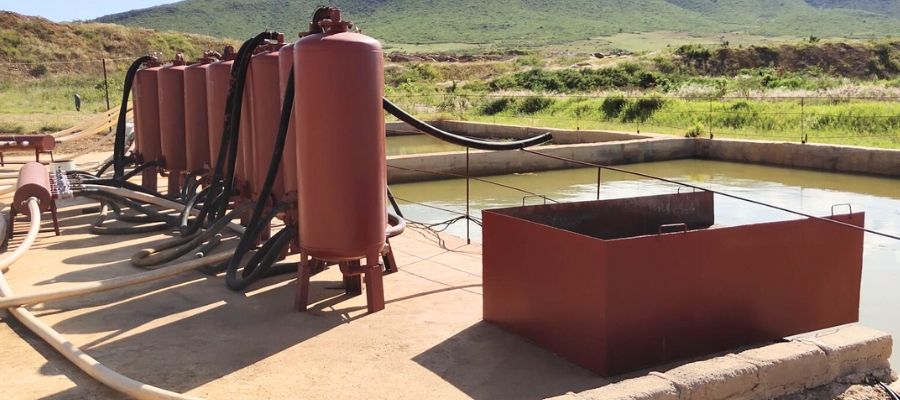
The common method of recovering gold from ore is to dissolve the gold through a cyanidation process and then adsorb it using activated carbon. According to the processing flow, the industry mainly applies three techniques: CIP (pulp carbon), CIL (carbon leach) and CIC (Column Carbon).
CIP Process (Carbon in Pulp)
In the CIP process, the cyanide pulp is mixed with activated carbon, and the gold in the solution is fixed on the surface of the carbon. In this method, leaching and adsorption are carried out in separate stages, facilitating process control.
Process flow:
- Mineral preparation: crushing and grinding of the mineral to form a fine pulp.
- Cyanide leaching: The pulp is mixed with a cyanide solution in stirring tanks, dissolving the gold and forming gold-cyanide complexes.
- Adsorption with activated carbon: Activated carbon is added to the already leached pulp. Gold is adsorbed using a countercurrent flow system, typically in 6 to 8 large adsorption tanks.
- Separation of gold-laden coal: Through screening or filtration, the loaded carbon is separated from the pulp.
- Desorption and electrodeposition: Gold is desorbed with an alkaline cyanide solution and recovered by electrodeposition.
- Coal regeneration: The desorbed carbon is washed and thermally reactivated before reuse.
Advantages:
- Separate leaching and adsorption, ideal for complex minerals.
- Mature process and relatively simple equipment.
- Suitable for solutions with different concentrations of gold.
CIL (Carbon Leaching) Process
The CIL process combines gold leaching and adsorption in the same reactor, increasing recovery efficiency, especially in complex minerals.
Process flow:
- Mineral preparation: crushing and grinding of the mineral.
- Simultaneous leaching and adsorption: in the leaching tanks the pulp is mixed with cyanide and activated carbon; gold is directly adsorbed during dissolution.
- Separation of loaded coal: by screening or filtration.
- Desorption and electrodeposition: same as in the CIP process.
- Coal regeneration: After desorption, the carbon undergoes regeneration and is reused.
Features:
- Simplified process flow, with simultaneous leaching and adsorption.
- High recovery efficiency (more than 90%).
- Lower initial investment, ideal for small scale plants.
CIC (Column Carbon) Process
The CIC process is used when the gold is already dissolved in a clear solution (for example, after heap leaching). The solution passes through columns filled with activated carbon, which adsorbs the gold.
Process flow:
- Mineral preparation: crushing and grinding.
- Cyanide leaching: dissolution of gold in solution.
- Column adsorption: the leached solution passes through columns with activated carbon.
- Desorption of charged carbon: extraction of gold from coal with alkaline solution.
- Carbon electrodeposition and regeneration: recovery of gold and reactivation of coal.
Features:
- Column adsorption suitable for low grade solutions with high fines content.
- Simple and economical process, ideal for small mines.
- High adsorption efficiency, although limited treatment capacity.
Each process has different requirements on the properties of activated carbon, such as low ash, high hardness, good adsorption capacity and abrasion resistance.
Selection of activated carbon for gold recovery

Coconut shell activated carbon
High K value, high R value, low ash, high hardness, specialized in gold recovery. Factory price, support bulk purchase.
Selecting the right activated carbon is key to achieving efficient gold adsorption. As a professional activated carbon supplier, we have extensive experience in gold recovery applications. We offer two main types of coconut shell activated carbon:
- Coconut shell granular activated carbon: ideal for CIP and CIL processes. Good fluidity and adsorption efficiency in pulp. Common sizes: mesh 6×12, 8×16.
- activated carbon in pellet coconut shell- Recommended for CIC processes or constant liquid flow systems. Typical 4mm diameter, low pressure drop and good hydrodynamic performance.
Advantages of our coconut shell activated carbon:
- High mechanical strength: low wear rate in CIP, CIL and CIC.
- Optimized porous structure: developed micro pores that favor the adsorption of gold ions.
- Excellent adsorption capacity: high values of R and K, which allows greater loading of gold per unit of carbon.
- Low ash content and few impurities: does not interfere with gold adsorption, improves recovery efficiency.
Conclusion
Thanks to its multiple advantages, the activated carbon adsorption method has proven to be highly effective in the extraction and recovery of gold, significantly improving the efficiency of the process.
PuroCarbon, with years of experience in activated carbon industry, supplies high quality coconut shell activated carbon specially designed for gold recovery. We can meet your bulk purchasing needs. If you are looking for a reliable activated carbon supplier, please feel free to contact us. contact with our professional team.