Activated Carbon for Decolorizing Edible Oils
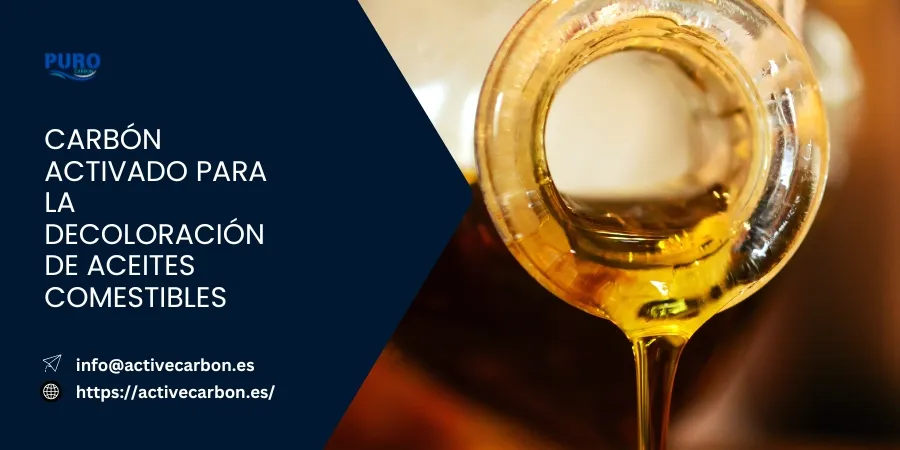
In the production of edible oils, natural or processed vegetable oils often contain impurities and pigments that not only affect their coloration, but also their flavor and quality. Therefore, the decolorization process becomes an indispensable step in oil refinement.
Thanks to its strong adsorption capacity, the activated carbon has been established as a key material in this process.
Principles of Action of Activated Carbon in the Decolorization of Edible Oils

Activated carbon is a porous material with high specific surface area and strong adsorption capacity. Its mechanism of action includes:
Physical Adsorption Mechanism for Pigment Removal
Activated carbon removes pigments primarily through physical adsorption, a process based on van der Waals forces—weak intermolecular attractions between the carbon surface and pigment molecules.
A critical factor for efficient bleaching is the Pore Distribution of coal. The main coloring agents in edible oils include:
- Chlorophyll
- Carotenoids
- Gossypol (in cottonseed oil)
- Oxidation products
These molecules have a size of 1-4 nanometers. Therefore, coals with a structure of Mesopores Well-developed pores (2-50 nm) are more effective, while micropores (<2 nm) help remove smaller impurities.
Selectivity in Complex Oil Matrix
Unlike other simple adsorbents, activated carbon, when specifically designed, shows exceptional selectivity. It can selectively adsorb unwanted pigments, minimizing the retention of beneficial components such as tocopherol (vitamin E) and phytosterols.
The surface chemistry of the carbon can be tuned to improve this selectivity. In vegetable oils such as soybean, sunflower or palm, a slightly acidic surface favors the adsorption of chlorophyll and carotenoids.
Key Performance Parameters
The following technical indicators are crucial in bleaching applications:
- Molasses index: Directly related to decolorization efficiency, it measures the carbon's ability to adsorb large molecules such as pigments. A high value indicates greater effectiveness.
- Bulk density: Essential for adequate filtering, it influences the packaging of carbon in the equipment. An optimal density guarantees uniform flow and prevents communication between particles.
- Particle size distribution: Affects adsorption kinetics and filtration efficiency. Smaller particles offer greater surface area but can make filtration more difficult.
- Ash content: Coals with low ash content are preferred to avoid the migration of minerals into the oil.
Method of using activated carbon in oil discoloration
Activated carbon is generally applied by the following processes:
- Addition of activated carbon: A certain proportion of charcoal is added to the hot oil, usually between 0.1% and 0.5% by weight.
- Agitation and contact: It is mixed at the appropriate temperature to ensure complete contact between the carbon and the oil, adsorbing pigments and impurities.
- Filtration or centrifugation: Using filter cloth, vacuum filtration or centrifugation, the carbon is separated from the oil, obtaining discolored oil.
In modern production, they combine clays, silica or other bleaching agents with activated carbon to further improve discoloration efficiency.
Activated Carbon for Decolorizing Edible Oils

Among the most used types, the Wood powdered activated carbon, specially designed for certain oils:
Structural advantages
Wood powder activated carbon has a structure rich in medium and large pores, which gives rise to a more open pore network. This characteristic makes it especially suitable for removing larger dye molecules, such as:
- Pigment complexes present in certain vegetable oils
- Palm oil carotenoids
- Polymerized pigment substances that form in oils subjected to thermal processing
Surface chemical properties
Wood-based activated carbon usually contains more oxygenated functional groups, which makes its surface properties more hydrophilic. This feature contributes to:
- Increase affinity for polar pigment compounds
- More effectively remove some difficult-to-treat metallic complex pigments
- Adsorb certain types of oxidation products
Advantages of your application
- Effective decolorization- Removes chlorophyll, carotenoids and other natural pigments from the oil, giving it a clear and transparent appearance.
- Improves oil quality- Reduces factors that catalyze oil oxidation (such as metal ions) and prolongs its useful life.
- Conservation of nutrients: Moderate use does not destroy the nutritional components of the oil, such as unsaturated fatty acids and vitamin E.
- Uniform decolorization: Powdered activated carbon is evenly dispersed in the oil, ensuring a homogeneous bleaching effect.
Recommended apps
Activated carbon in wood powder is especially suitable for:
- High chromatic intensity ecrus that require deep bleaching
- Petroleum products especially sensitive to certain pigments (such as chlorophyll)
- Applications where the bleaching process must be performed at lower temperatures
- Refining processes in which the final product is required to present a specific shade, and not only the general chromatic intensity is taken into account
Conclusion
Activated carbon is essential in the decolorization of oils, improving not only their appearance but also their stability. Selecting the correct type and its application method are key to obtaining high quality products.
¡Contact us at today to request free samples and custom solutions!