Gas Desulfurization with Activated Carbon
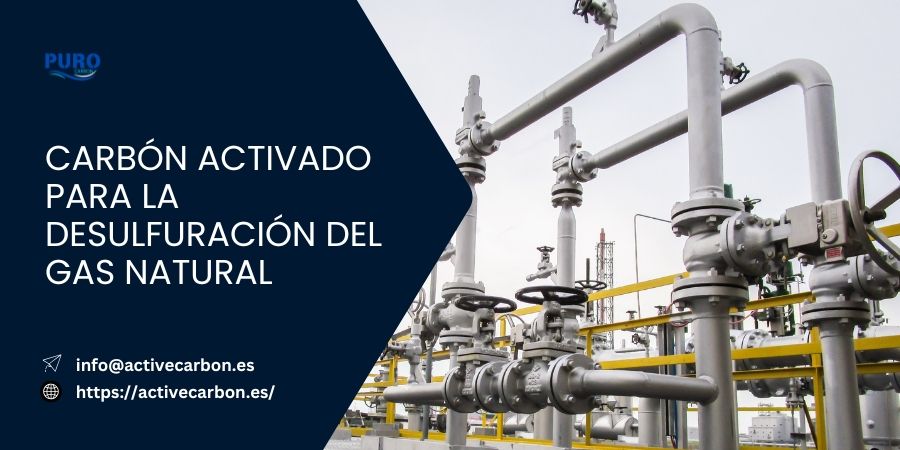
Natural gas is an important energy source, widely used for electricity generation, heating and industrial production. However, natural gas often contains sulfur compounds, such as hydrogen sulfide (H2S), which are hazardous to equipment, the environment, and human health. That is why it is necessary to desulfurize it.
Activated carbon excels at sulfide removal due to its unique pore structure and chemical properties. In this article we will take a closer look at the application of activated carbon in natural gas desulfurization.
What is activated carbon? How does it work in the desulfurization of natural gas?

Activated carbon is a highly porous material that is produced from raw materials such as coconut shells, coal, anthracite or wood. Its high specific surface area makes it an excellent adsorbent, capable of capturing and eliminating various chemical compounds present in gases, including sulfur compounds from natural gas.
Operating principle in desulfurization
In the desulfurization process of natural gas, activated carbon acts as an adsorbent, eliminating sulfur compounds such as H₂S and mercaptans through Physical adsorption and chemical reactions. This process is based on the following main mechanisms:
- Physical adsorption: Activated carbon can physically adsorb sulfur compounds such as hydrogen sulfide (H₂S) thanks to its micropore structure. These sulfur molecules are separated from the gas phase by becoming trapped in the pores of the coal.
- Catalytic oxidation: Some types of modified activated carbon have catalytic properties that allow hydrogen sulfide to be oxidized into elemental sulfur or sulfur dioxide (SO₂). These sulfur products are subsequently adsorbed on the coal surface.
- Chemical reactions: The active sites on the surface of activated carbon can chemically react with H₂S to form stable sulfur compounds.
Thanks to these mechanisms, activated carbon not only effectively removes contaminants, but also protects industrial equipment against corrosion caused by H₂S.
Applications of activated carbon in the desulfurization of natural gas
Activated carbon plays an irreplaceable role in many natural gas desulfurization scenarios. Below are some of the most common use cases and associated industrial needs:
Natural gas processing plants

In the process of extraction and treatment of natural gas, raw gas usually contains large amounts of hydrogen sulfide (H₂S) and organic sulfur compounds. These compounds not only corrode equipment, but also affect gas quality and downstream processes. Activated carbon effectively removes sulfur compounds, ensuring natural gas meets industrial standards and extends the life of equipment.
Production of liquefied natural gas

The natural gas liquefaction process requires extremely pure gas. Even small amounts of hydrogen sulfide or sulfur compounds can seriously damage liquefaction equipment. Therefore, in LNG production, activated carbon is often a key step for deep gas purification.
biogas purification

Biogas, a renewable energy source, is generated from organic waste or landfill biogas. However, raw biogas contains high concentrations of hydrogen sulfide (H₂S), which must be removed during the purification process. Activated carbon, thanks to its high capacity to adsorb H₂S, is widely used in biogas desulfurization systems.
Use of natural gas in the chemical industry
In the chemical industry, natural gas is used as a raw material or fuel. For example, in the production of ammonia, methanol or hydrogen, the purity of natural gas directly affects the efficiency of chemical reactions and the quality of the product. Activated carbon effectively removes sulfur compounds, ensuring that natural gas is suitable for the most demanding chemical processes.
Transportation by gas pipelines

During the mass transportation of natural gas, sulfur compounds can not only corrode pipelines, but also pose a risk to the safety of the gas pipeline network. Activated carbon can effectively adsorb sulfur compounds and other impurities, ensuring that natural gas remains stable and safe during transportation.
Industrial gas boilers
Gas boilers are widely used in industrial production. However, natural gas containing sulfur compounds releases sulfur dioxide (SO₂) when burned, which causes environmental pollution and accelerates equipment wear. The use of activated carbon to purify natural gas effectively reduces the content of sulfur compounds, reduces polluting emissions and meets environmental standards.
Activated carbon for natural gas desulfurization
The selection of the appropriate activated carbon is key to guarantee the efficiency of the desulfurization process and optimize the systems. Here are some common types of activated carbon and their characteristics:
Granular activated carbon

Granular activated carbon
Large quantity supply, high hardness, excellent price advantage, meet diversified desulfurization needs.
Our granular activated carbon is produced from high quality coal. It has high mechanical resistance, which allows it to withstand impacts and wear, making it ideal for prolonged operating environments. Its resistance to wear also makes it suitable for desulfurization systems with high gas flow rates, prolonging the useful life of the product.
- High adsorption speed.
- High mechanical resistance and durability.
- Low pressure drop.
- Particularly suitable for the removal of sulfur compounds at low concentrations.
Impregnated activated carbon

Impregnated activated carbon
Improved adsorption properties and a wide range of impregnation types to meet various desulfurization needs.
This type of activated carbon is treated with special chemical agents (such as metal oxides) to significantly improve its ability to react with H₂S. It is the ideal choice for applications requiring deep desulfurization.
- Improved adsorption performance.
- High chemical adsorption capacity.
- High efficiency in desulfurization.
- Suitable for the removal of sulfur compounds at high concentrations.
Conclusion
Desulfurization of natural gas is a fundamental step to guarantee gas quality, safety and compliance with environmental regulations. Activated carbon, thanks to its high adsorption capacity, has become an essential material in desulfurization processes.
PuroCarbon S.L., as a professional activated carbon supplier, offers high-quality customized products and solutions for natural gas desulfurization. Our products are designed to adapt to various raw materials and operating conditions, satisfying the specific needs of our customers. If you are looking for a reliable activated carbon supplier, please feel free to contact us at.