Activated Carbon Powder: Properties, Applications and Selection Guide
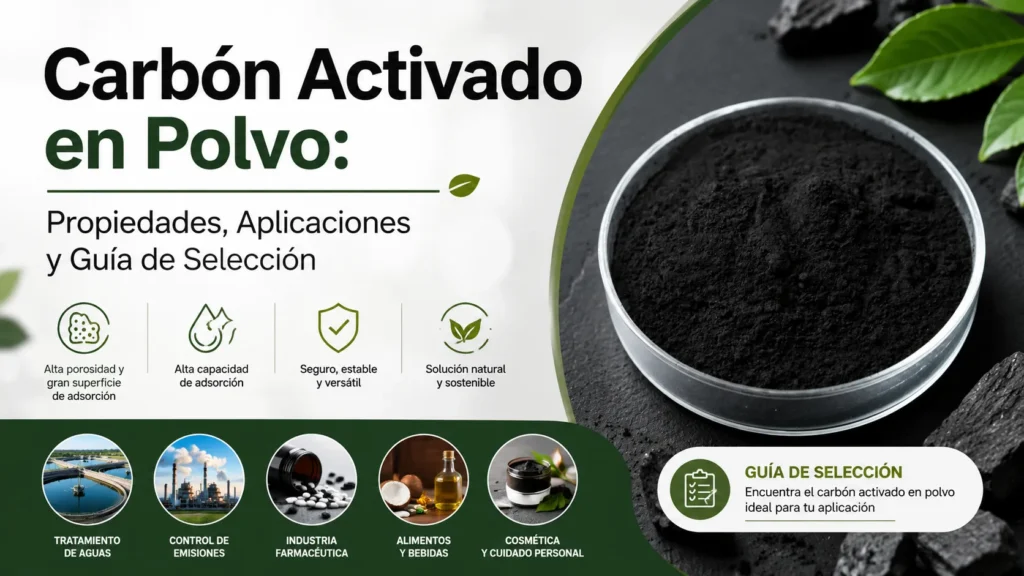
The Powdered activated carbon It is one of the most versatile and widely used forms of activated carbon in the industrial field. Unlike granular activated carbon, powder activated carbon is a fine powder whose particle sizes are typically less than 150 micrometers. This characteristic gives powdered activated carbon an extremely large specific surface area and an extremely fast adsorption rate.
In this comprehensive guide, we explore their properties, manufacturing methods, industrial applications and selection criteria to help you choose the right product for your needs.
What Is Activated carbon Powder?
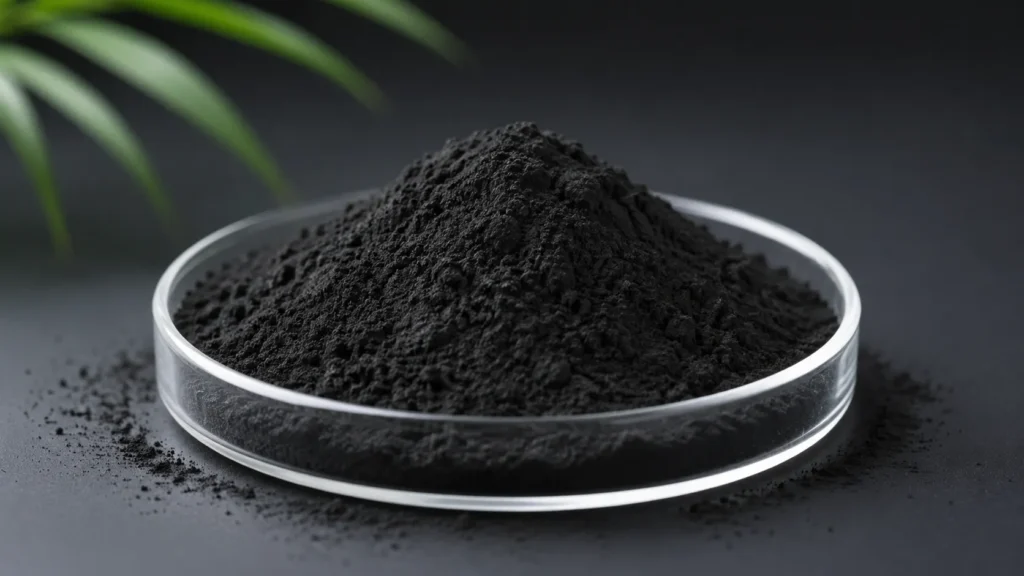
The Powdered activated carbon It is a porous carbonaceous material, thermally or chemically treated to develop an internal network of pores that gives it an exceptional adsorption capacity. Its distinctive characteristic is its presentation in powder form, with particle sizes ranging between 5 and 150 μm (100 to 300+ meshes), which maximizes the external surface area available for contact with the fluid to be treated.
The key properties that define a powdered activated carbon are:
- Specific surface area: Between 800 and 1,500 m²/g, one of the highest among all industrial adsorbent materials.
- Porous structure: Combination of micropores (< 2 nm), mesopores (2-50 nm) and macropores (> 50 nm) in variable proportions depending on the raw material and the activation method.
- High surface reactivity: Oxygenated functional groups (hydroxyl, carboxyl, carbonyl, lactone) that modify adsorption selectivity.
- Fine granulometry: It allows uniform dispersion in liquids and intimate contact with the medium to be treated.
Manufacturing Methods of Powdered Activated Carbon
The manufacturing process of powdered activated carbon consists of two main stages: Carbonization and the Activation. The choice of activation method fundamentally determines the properties of the final product.
Physical activation
Physical activation uses oxidizing gases—typically water vapor at 800-1,000°C or CO₂ at 600-900°C—to remove uncarbonized material and develop the pore network. This method produces coals with:
- Predominance of micropores
- High surface area (900-1,200 m²/g)
- Relatively nonpolar (hydrophobic) surface
- Lower content of surface oxygenated functional groups
- Ideal for adsorption of volatile organic compounds and small molecules
Chemical activation
Chemical activation impregnates the raw material with activating agents – mainly phosphoric acid (H₃PO₄), potassium hydroxide (KOH) or zinc chloride (ZnCl₂) – before heating to lower temperatures (400-700 °C). This method produces coals with:
- Greater development of mesopores
- Very high surface area (up to 1,500-2,500 m²/g with KOH)
- Higher density of oxygenated surface functional groups
- Ideal for adsorption of large molecules (dyes, polymers, dissolved organic matter)
- Lower energy consumption during manufacturing
Raw Materials Used
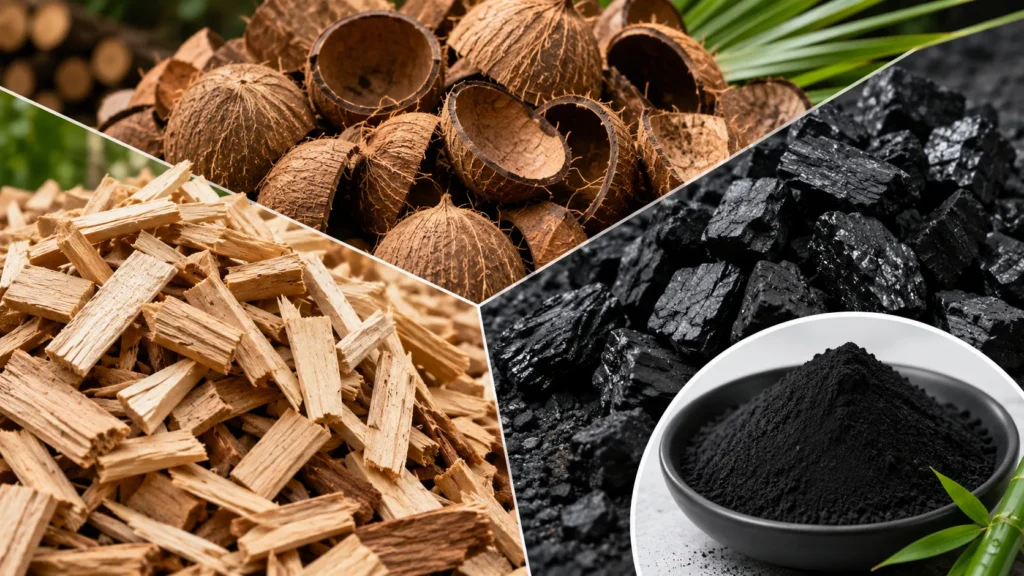
The raw material significantly influences the structure and properties of the resulting powdered activated carbon:
- Wood Based Powdered Activated Carbon- Made from high quality wood (birch, oak, beech and pine), it is an ideal material for liquid treatment and decolorization.
- Coconut Shell Powder Activated carbon Powder: produced from coconut shells, it is characterized by its high hardness and low ash content, which makes it very suitable for the adsorption of gases and small molecules.
- coal-based powder activated carbon: produced from lignite and anthracite, it offers exceptional value for money.
Technical Specifications of Activated Carbon Powder
| Parameter | Unit | Typical Range | Test Method |
|---|---|---|---|
| Surface Area (BET) | m²/g | 900 – 1,300 | ASTM D6556 |
| Iodine value | mg/g | 900 – 1,100 | ASTM D4607 |
| Methylene Blue Value | mL/0.15g | 15 – 30 | ASTM C837 |
| Molasses Number | — | 150 – 300 | AWWA B600 |
| Particle size | mesh | 200-325 | Laser analysis |
| Sieve (% mesh pass 200) | % | ≥ 95 | ASTM D2862 |
| Humidity | % | ≤ 10 | ASTM D2867 |
| Ash Content | % | ≤ 8 | ASTM D2866 |
| Bulk density | g/cm³ | 0.25 – 0.50 | ASTM D2854 |
| pH | — | 5 – 9 | ASTM D3838 |
Main Industrial Applications
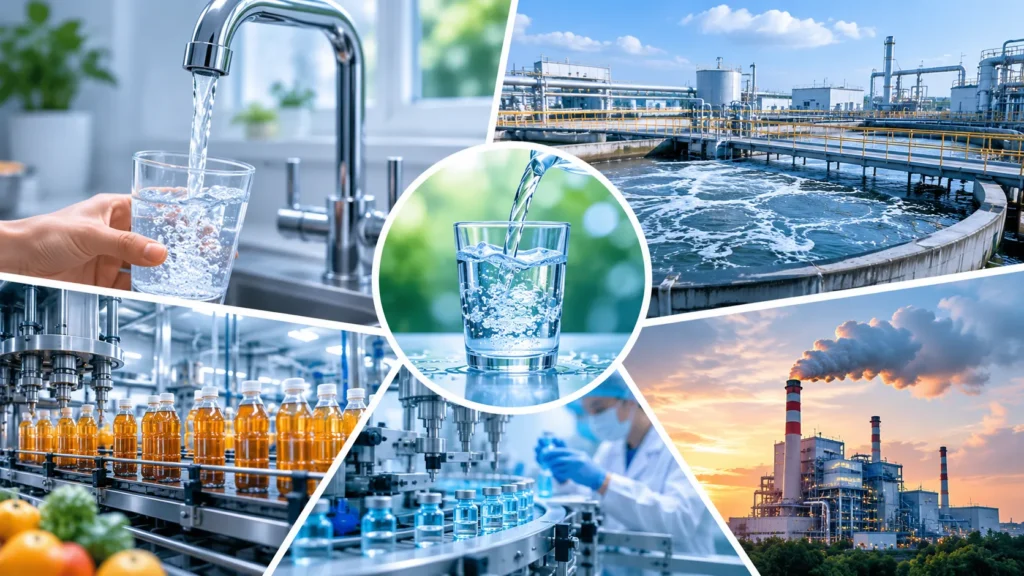
Powdered activated carbon is used in a wide variety of industrial sectors. The most relevant applications are detailed below:
Drinking Water Treatment
Powdered activated carbon is the reference adsorbent for the removal of:
- Organic compounds that cause taste and odor (geosmin, 2-MIB)
- Disinfection byproducts (trihalomethanes, haloacetic acids)
- Pesticides and herbicides (atrazine, simazine)
- Emerging contaminants (pharmaceuticals, personal care products)
- Microcystins (blue-green algae toxins)
It is dosed directly into the water stream, generally in contact tanks or before filtration, with doses of 2-50 mg/L depending on the contaminant to be eliminated.
Industrial wastewater treatment
Applied in the treatment of effluents from chemical, pharmaceutical, petrochemical, textile and tanning industries to eliminate:
- Dyes and textile dyes
- Phenols and aromatic compounds
- Surfactants and detergents
- Heavy metals (in combination with other treatments)
- Recalcitrant organic matter (non-biodegradable COD)
decolorization of food and beverages
Food grade activated carbon powder is used for:
- Clarification and decolorization of fruit juices (apple, grape, pear)
- Whitening sugar and glucose syrup
- Decolorization of edible oils
- Purification of wines and spirits
- Process water treatment in the brewing industry
Pharmaceutical and Chemical Industry
- Purification of active pharmaceutical ingredients (API)
- Removal of residual catalysts and dyes
- Recrystallization of fine chemicals
- Blood and plasma treatment (hemoperfusion)
Elimination of Mercury in Flue Gases
- Improvement of adsorption capacity by chemical modification (e.g. bromination).
- Removal of gaseous mercury in combustion gases from coal plants.
- Reduction of mercury emissions in waste incineration processes.
- Efficient adsorption of elemental mercury and oxidized mercury.
Advantages of Powdered Activated Carbon over Granular
| Feature | Powdered Activated Carbon | Granular activated carbon |
|---|---|---|
| Surface area | Higher, large adsorption capacity | Relatively lower, but suitable for handling large volumes of contaminants |
| Adsorption rate | Short diffusion path, fast adsorption rate | Long diffusion path, slow adsorption rate |
| Application Scenario | Easy to disperse, suitable for rapid treatment of liquid or gaseous contaminants | Commonly used for long-term, persistent treatment of contaminants, such as in large water treatment equipment |
| Dosage method | Can be dosed directly, easy to apply | Installed in filtration equipment or filling beds |
| Price | Lowest unit price | Higher unit price |
| Regeneration capacity | Normally not regenerated, mostly disposable use | Can be regenerated several times, suitable for long-term applications |
| Flexibility | Flexible dosing, with the ability to adapt to different contamination environments | Less flexibility, depends on fixed equipment |
| Cost of use | Low (disposable and does not require regeneration) | High (requires specialized equipment for regeneration and long-term maintenance) |
The choice between powdered activated carbon and granular activated carbon depends mainly on the process: for batch, variable dose and liquid treatments, powdered activated carbon is the preferred option; For continuous systems, fixed beds and gas treatments, granular activated carbon is more suitable.
Powdered Activated Carbon Selection Criteria
To choose the right activated carbon powder for your application, consider the following factors:
- Iodine Index vs. Molasses Number: The iodine value measures the adsorption capacity of small molecules (micropores), while the molasses number evaluates the adsorption of large molecules (mesopores). Choose based on the size of the target contaminant.
- Required purity level: For food and pharmaceutical applications, require food grade and low ash and heavy metal certifications.
- Granulometry: For fast mixing systems, prefer finer powders (d50 < 25 μm). For diatomaceous earth filtration, an intermediate size (d50 30-50 μm) may be more practical.
- Charcoal pH: Verify that the pH of the carbon is compatible with the fluid to be treated. A very acidic or very alkaline pH can interfere with the process.
- Batch consistency: Choose a supplier that ensures consistent specifications from batch to batch, backed by certificates of analysis for each delivery.
Conclusion
Activated carbon powder is a high-performance adsorbent material; Its fast adsorption kinetics, high adsorption capacity and flexible dosage control make it an indispensable tool in modern industry.
PuroCarbon produces powdered activated carbon from various raw materials, which can be customized for different industrial applications. Get in contact with us today and our team of experts will help you find the best solution.