Why Is Powdered Activated Carbon Used to Decolorize Dyeing Wastewater?
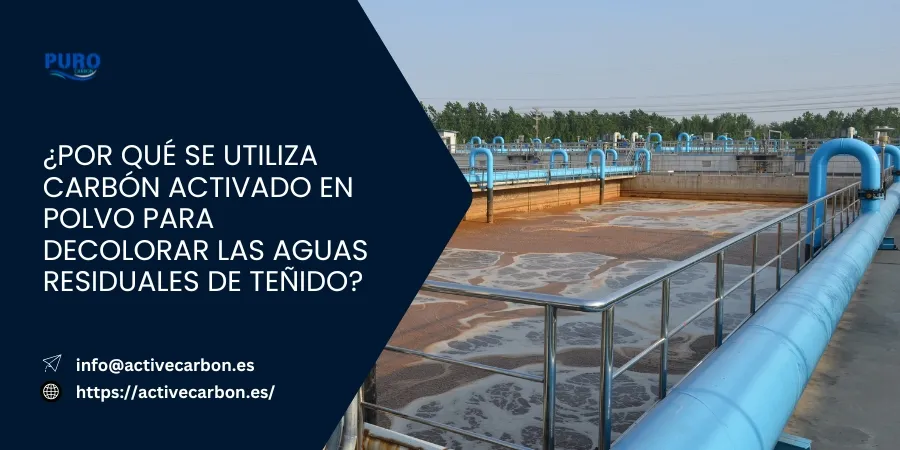
In textile production, the printing and dyeing process generates considerable volumes of wastewater that is characterized by high color intensity, high chemical oxygen demand (COD), complex composition and low biodegradability. Failure to treat this effluent to regulatory standards jeopardizes compliance with discharge requirements.
Among the various bleaching techniques, the Powdered activated carbon has become a predominant solution for advanced decolorization of printing and dyeing wastewater, due to its highly effective adsorption properties.
Why is it difficult to decolorize textile wastewater?

Textile wastewater usually contains:
- Reactive dyes
- Disperse dyes
- Direct dyes
- acid dyes
- Surfactants
- Residues of chemical auxiliaries
These organic pigments have stable molecular structures, high molecular weight and, in many cases, structures with aromatic rings. Therefore, biological treatment alone is difficult to completely eliminate them. Even after biological treatment, a certain level of color usually remains, making an advanced bleaching stage necessary.
Decolorization mechanism of activated carbon powder
Powdered activated carbon is characterized by:
- Well developed mesopore structure
- High specific surface
- Abundant functional groups on the surface
Its decolorization mechanism mainly includes:
- Physical adsorption: The surface of activated carbon has a large number of micropores and mesopores that allow dye molecules to be adsorbed through Van der Waals forces.
- Pore Size Matching Adsorption: Dye molecules in textile wastewater are usually large; The mesoporous structure (2–50 nm) of powdered activated carbon favors the adsorption of these macromolecular compounds.
- Surface chemical interaction: Some dye molecules can react with the oxygenated functional groups of activated carbon, increasing the removal efficiency.
Why is activated carbon powder recommended?

Although he Granular activated carbon It is widely used in continuous filtration systems, from the point of view of decolorization efficiency, reaction speed and engineering adaptability, the Wood Powder Activated carbon best fits the characteristics of textile wastewater.
Dye molecules are large and require a more open pore structure
Dyes in textile wastewater typically:
- Have complex structure
- Have high molecular weight
- Contain multiple aromatic rings
These macromolecules are more easily adsorbed on activated carbons with well-developed mesopores. Powdered activated carbon generally possesses a richer mesopore distribution, providing better “diffusion channels” for dyes and improving adsorption efficiency.
Higher contact efficiency
Powdered activated carbon has a very small particle size (generally <200 mesh), which allows it to be uniformly dispersed in water after dosing:
- Complete contact with contaminants
- Without limitations of a fixed bed
- Faster adsorption kinetics
Instead, granular activated carbon requires water to flow through a fixed bed, where there are:
- Resistance to external diffusion
- Internal diffusion resistance
- Slower mass transfer rate
For highly colored waters that need to quickly meet discharge standards, powdered activated carbon offers greater advantages.
Best suited for batch treatments and emergency situations
In the textile industry it is common to find:
- Batch production
- Wide variation in water quality
- Sudden increases in color
Powdered activated carbon allows the dosage to be flexibly adjusted according to the quality of the water, being especially suitable for:
- Advanced treatment stages
- Emergency decolorization
- Reinforcement of the effluent after biological treatment
This flexibility is difficult to achieve with fixed bed systems with granular carbon.
Faster adsorption rate, ideal for high loads
In textile wastewater with high color intensity, time is a key factor in operating costs.
Activated carbon powder, thanks to:
- Its large specific surface
- Greater proportion of external surface
- Short diffusion path
It can reach adsorption equilibrium in less time, significantly reducing the treatment cycle.
Easy integration with coagulation processes
In real applications, powdered activated carbon is usually combined with:
- PAC (polyaluminum chloride)
- PAM (polyacrylamide polymer)
The usual process is:
Dosing of powdered activated carbon → Adsorption → Coagulation → Sedimentation or flotation by dissolved air → Treated effluent
This combination significantly improves:
- color removal
- COD reduction (COD)
- The stability of the final effluent
Lower initial investment
The use of granular activated carbon generally requires:
- Construction of adsorption towers
- Backwash systems
- Periodic replacement of filter material
While powdered activated carbon only needs:
- Dosing system
- Coagulation-sedimentation or flotation system
For companies that already have treatment facilities, the cost of adaptation is considerably lower.
Key factors influencing decolorization efficiency
- Application dose (common range: 50–500 mg/L)
- Contact time
- Wastewater pH
- Temperature
- Colorant type
- Iodine value and pore structure of activated carbon
Laboratory tests (pilot trials) are recommended to determine the optimal dosage.
Conclusion
Textile wastewater is characterized by high color intensity, complex composition and low biodegradability. Compared to other bleaching methods, powdered activated carbon stands out for:
- Developed pore structure
- High adsorption rate
- Flexible dosing
- Excellent fading performance
Therefore, it has become a key material for the deep bleaching of textile wastewater.
Contact us at to select activated carbon powder with the most suitable pore structure and adsorption capacity, improve treatment efficiency and optimize operating costs.