Activated carbon to Decolorize Beet Sugar
In the sugar industry, the beet sugar decolorization It is a key stage to improve product quality and meet food grade standards. Compared to cane sugar, beet sugar is more susceptible to being affected by raw material composition and processing conditions, which can lead to unwanted coloration.
If the decolorization is not complete, it not only affects the appearance, but also reduces the added value of the product. This article systematically presents the application of the activated carbon in the decolorization of beet sugar.
Why is it necessary to decolorize beet sugar?
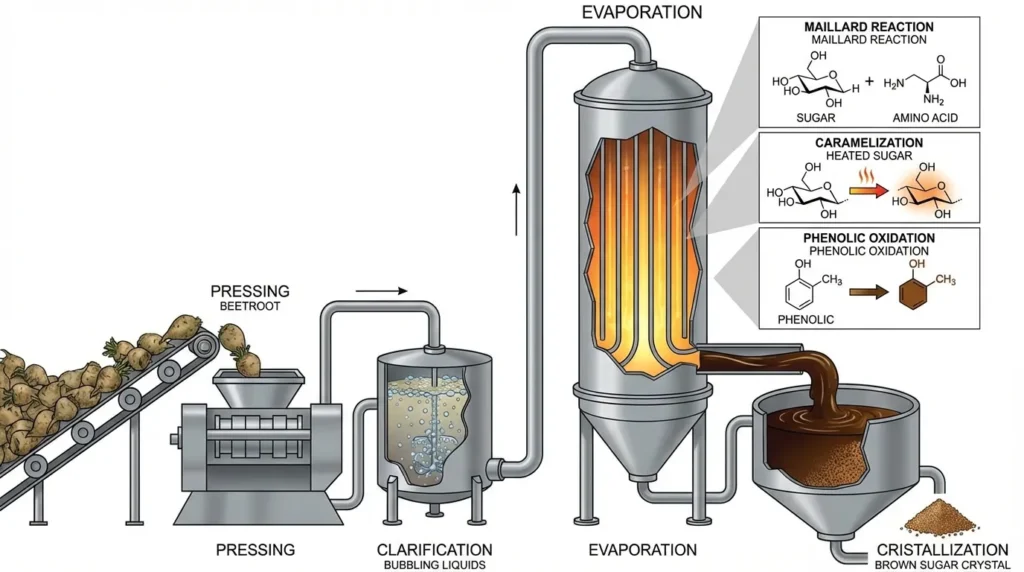
Beet is one of the main raw materials for sugar production worldwide, widely cultivated in Europe, North America and some regions of Asia. The beet sugar production process includes pressing, clarification, evaporation and crystallization.
During processing, colored substances naturally present in the raw material or generated during process reactions dissolve in the sugary liquor, causing it to acquire a yellow or even brown color. Especially in the high temperature evaporation stage, the following reactions can occur:
- Maillard reaction (reaction between sugars and amino compounds)
- Caramelization reaction
- Oxidation of phenolic compounds
These reactions generate colored substances of different molecular weights, increasing the color value of the syrup.
Therefore, performing effective decolorization before crystallization is a key step to obtain high whiteness refined sugar.
Main sources of color in beet sugar

The compounds responsible for the color in beet sugar come mainly from:
- Phenolic compounds: present in the beet itself, with a tendency to oxidize.
- amino compounds: they react with reducing sugars forming dark colored substances.
- Caramelization pigments: generated during evaporation at high temperature.
- Organic acids and impure byproducts: formed during alkaline and lime treatments, creating complex colored structures.
These substances have a wide molecular weight distribution, including both low molecular weight pigments and high molecular weight colloidal pigments. Therefore, the decolorization material must have:
- Well-developed micropore structure
- An adequate proportion of mesopores and macropores
- Good surface chemical properties
Common beet sugar decolorization methods
In the industry, the most used methods include:
- Ion exchange resins: suitable for refining stages, although with higher operating costs.
- Adsorption with activated carbon: the most widely used method, especially in the pre-decolorization and deep decolorization of sugary liquor.
- Membrane separation technology: effective for small molecules, but with high initial investment.
Among them, the Activated Carbon Adsorption It stands out for its high efficiency, stability and good cost-benefit ratio, becoming the most used method in the production of beet sugar.
Mechanism of activated carbon in the decolorization of beet sugar
Activated carbon is a porous adsorbent material with a large specific surface area and a developed pore structure. Its decolorization mechanism mainly includes:
Physical adsorption
Thanks to its developed porous structure, activated carbon can adsorb pigments of different molecular sizes present in the sugar liquor through Van der Waals forces, such as:
- Phenolic compounds
- Caramelization products
- Low molecular weight organic pigments
- High molecular weight pigments
- Humic substances
- Protein degradation products
The large specific surface area allows the colored molecules to be retained within the pores, thus achieving decolorization.
Chemical adsorption
In addition to physical adsorption, the surface of activated carbon contains various oxygenated functional groups, such as:
- Carboxyl (–COOH)
- Hydroxyl (–OH)
- Carbonyl (C=O)
These groups can interact with the colored molecules through:
- hydrogen bonds
- electrostatic attraction
- π-π interactions
Especially in the case of pigments with aromatic structures (such as phenolic compounds), the π-π interaction is particularly significant.
Types of activated carbon used in beet sugar decolorization

The activated carbon used in the decolorization of beet sugar must have an adequate mesoporous structure, a high decolorization capacity and a low ash content, to avoid affecting the purity and flavor of the sugar. PuroCarbon offers wood-based powder activated carbon High quality, specially designed for bleaching applications.
Developed mesoporous structure
The main pigments in beet sugar liquor include:
- High molecular weight polyphenols
- Humic substances
- Protein degradation products
- High molecular weight caramelization pigments
Due to their large molecular size, these compounds cannot easily penetrate exclusively microporous structures. Wood-based activated carbon has a higher proportion of mesopores, which allows:
- Improve the diffusion of large molecules
- Increase adsorption efficiency
- Significantly reduce the ICUMSA value
High fading speed
Powdered activated carbon has a small particle size and a large specific surface area, which allows:
- Quick and uniform contact with the sugary liquor
- Efficient adsorption in a short time
- Suitable application in batch bleaching processes
This is essential to improve production efficiency and reduce processing times.
Low ash content and low presence of impurities
Food grade beet sugar demands high safety standards. High-quality wood-based activated carbon powder offers:
- Low ash content
- Low heavy metal content
- stable pH
- No impact on sugar taste
It thus meets the requirements of the food industry.
Conclusion
In the decolorization process of beet sugar, wood-based activated carbon powder, thanks to its developed meso- and macropore structure and excellent adsorption capacity, becomes the most suitable choice for removing natural pigments and pigments generated during processing.
Contact us at now to get free samples and customized solutions.