Activated Carbon for COD Removal from Industrial Wastewater
In industrial processes, the accumulation of organic compounds that are difficult to degrade has always been a central problem that affects companies. Especially in key industries such as chemicals, textiles and pharmaceuticals, high levels of COD (Chemical Oxygen Demand) not only violate emission standards but also cause serious damage to the aquatic ecosystem.
The activated carbon, with its unique porous structure and powerful adsorption capacity, demonstrates excellent performance in industrial wastewater treatment. This article details the role of activated carbon in removing COD in industrial wastewater, helping companies solve this challenge.
Why is Deep COD Treatment Necessary?
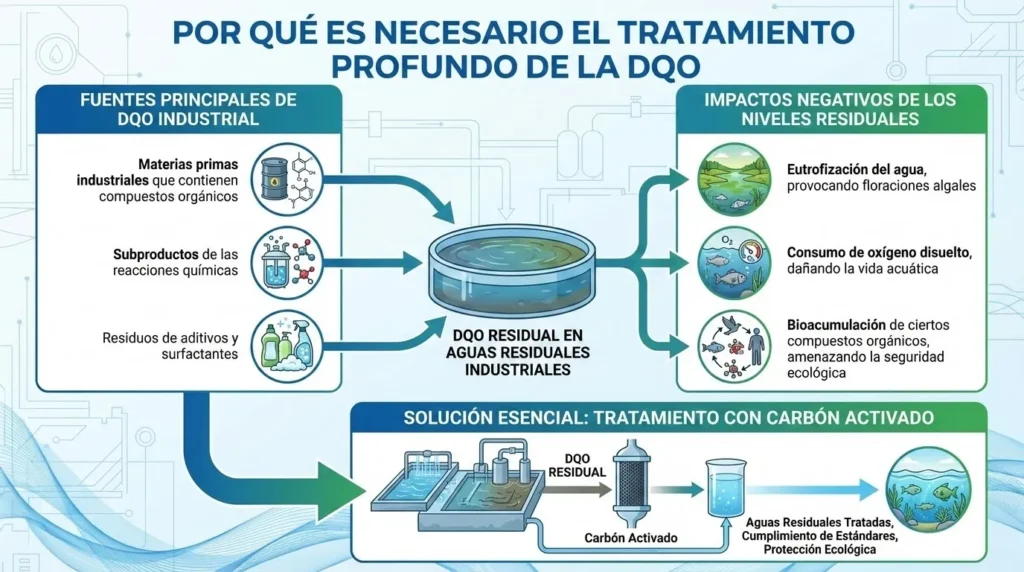
COD in industrial wastewater comes mainly from:
- Industrial raw materials containing organic compounds
- Byproducts of chemical reactions
- Residues of additives and surfactants
Residual COD levels not only affect compliance with emission standards, but also cause:
- Eutrophication of water, causing algal blooms
- Consumption of dissolved oxygen, damaging aquatic life
- Bioaccumulation of certain organic compounds, threatening ecological security
Therefore, it is essential to use activated carbon to treat COD in wastewater.
Adsorption Mechanism: The Role of Activated Carbon in COD Removal

Activated carbon removes COD mainly through adsorption:
Adsorption by Porous Structure
Activated carbon has a highly developed porous structure:
- Micropores (<2 nm): Adsorb small organic molecules (such as low molecular weight COD).
- Mesopores (2–50 nm): They adsorb large organic molecules (dyes, surfactants).
- Macropores (>50 nm): They act as transportation channels, improving efficiency.
Organic compounds are trapped in the pores by concentration gradients and molecular forces, thus reducing COD.
Surface Physical Adsorption
The surface of activated carbon has a high surface area that favors:
- Van der Waals forces
- Hydrophobic effects
- Intermolecular attraction
It is especially effective for hydrophobic organic compounds that are difficult to degrade biologically.
Chemical Adsorption by Functional Groups
The surface of activated carbon contains oxygenated groups such as:
- Hydroxyls (–OH)
- Carboxyls (–COOH)
- Carbonyl groups (–C=O)
These groups can interact with organic compounds through:
- hydrogen bonds
- Coordination adsorption
- Weak chemical bonds
Improving the elimination of polar and oxygenated compounds.
Specialized Activated Carbon for COD Treatment
Selecting the right activated carbon is crucial for effective COD removal. Purocarbon offers various optimized solutions for water treatment.
Granular activated carbon

The Granular activated carbon It operates in fixed beds, being ideal for large-scale treatment plants due to its high mechanical resistance and prolonged stability.
Structural Features:
- Uniform particle distribution
- Suitable density
- High mechanical strength
- Large surface area
Engineering Advantages:
- Continuous fixed bed operation
- Precise control of hydraulic contact time
- Regeneration by backwash
- Low pressure loss, reducing energy costs
This system is especially suitable for industrial companies with stable water volumes that require long-term continuous treatment.
Powdered Activated Carbon

The Powdered activated carbon stands out for its quick response and flexibility, being ideal for treating fluctuations in the contaminant load. Its ultra-thin size maximizes contact with contaminants.
Structural Features:
- Fine particles
- High proportion of mesopores
- Abundance of functional groups
- Fast adsorption rate
Engineering Advantages:
- Adaptive dosing
- High efficiency in emergencies
- Compatible with coagulation-flocculation
- Does not require specialized equipment
This system is ideal for intermittent processing or as a complementary solution to fixed bed systems, and is especially suited to the flexible processing requirements of small and medium-sized businesses.
Applied Engineering Solutions
In real projects, the use of activated carbon requires a systemic design that considers:
Optimum Application Points
Main Locations:
- Tertiary treatment after biological processes
- Polished filtration for reuse
- Pretreatment of water with high organic load
Recommended Combinations:
- Filtration + Adsorption
- Coagulation + Adsorption
- Ozone + Adsorption
Key Operating Parameters
Critical Variables:
- Contact time (EBCT): 20-40 min
- Filtration speed: 5-10 m/h
- Backwash frequency: 48-72 h
- Optimum temperature: 15-35°C
Monitoring Indicators:
- Inlet/outlet COD differential
- Pressure loss
- Effluent turbidity
- pH variations
Operational Maintenance
- Periodic backwashes
- Online monitoring
- Scheduled regeneration
- Analytical sampling
Conclusion
Activated carbon is a reliable solution for recalcitrant COD in industrial wastewater. With technical selection and optimized operation, it guarantees regulatory compliance.
PuroCarbon offers specialized solutions – Contact us at for free trials and personalized advice.