Activated Carbon for Biopharmaceutical Purification
The biopharmaceutical industry demands extraordinarily high levels of purity. From the production of monoclonal antibodies to the synthesis of active pharmaceutical ingredients (APIs), any trace contaminant—pyrogenic, residual dyes, endotoxins, solvents, degradation products—can compromise drug safety and regulatory compliance.
Activated carbon has become the preferred material for the purification of biopharmaceutical products, thanks to its ability to effectively and selectively adsorb organic contaminants.
Why is activated carbon used in biopharmaceuticals?
Activated carbon acts through the mechanism of Physical adsorption: the contaminant molecules are fixed on the extensive network of micropores and mesopores of the carbonaceous surface thanks to Van der Waals forces. With specific surfaces of between 800 and 1,500 m²/g, it is capable of retaining with great efficiency:
- Residual dyes and pigments from fermentation or chemical synthesis processes
- Volatile and semivolatile organic compounds (reaction solvents, synthesis byproducts)
- Pyrogens and endotoxins low molecular weight
- Bitter compounds, odors and flavors unwanted in oral formulations
- Degradation products of the active ingredient or excipients
- Residual metal catalysts (Pd, Pt, Ni, Ru) from hydrogenation reactions
- Process dyes (e.g. methylene blue, organic indicators)
Key applications in the biopharmaceutical industry
Thanks to its excellent adsorption properties, activated carbon is used in various areas of the biopharmaceutical industry.
Decolorization and purification of API (Active Pharmaceutical Ingredients)
During the chemical or biotechnological synthesis of active ingredients, colored by-products are generated that must be removed before packaging. Treatment with powdered activated carbon in aqueous solution or organic solvent allows these contaminants to be reduced below the limits established in international pharmacopoeias (Ph. Eur., USP, JP). Bleaching is usually done in batches (batch treatment) at temperatures between 20 and 70 °C, followed by filtration to remove carbon.
Purification of sugar solutions and fermentation media
In the production of antibiotics, vitamins and bioferments, culture broths contain melanoidins, Maillard compounds and other colored products. Activated carbon removes these compounds without significantly affecting the performance of the product of interest, as long as the contact conditions (dose, time, pH and temperature) are correctly controlled.
Removal of residual metal catalysts
Catalytic hydrogenation reactions, widely used in pharmaceutical synthesis, leave traces of precious metals—Pd, Pt, Rh, Ni—in the product. Activated carbon can be used as a secondary adsorbent to reduce these metal residues to the limits required by ICH Q3D (Guideline for Elemental Impurities), thanks to the presence of surface functional groups capable of chelating metal cations.
Water purification for pharmaceutical use (WFI and Purified Water)
Pharmaceutical water treatment systems include granular activated carbon stages for the removal of residual chlorine, chloramines, trihalomethanes and trace organic compounds. Water free of these impurities is essential to protect reverse osmosis membranes, ion exchange resins and, ultimately, to ensure the purity of the process water.
Decolorization of gelatin solutions and excipients
In the manufacture of gelatin capsules, lactose solutions or syrups, powdered activated carbon is used to improve the visual appearance of the final product, removing pigments, caramelization compounds and other color-altering impurities.
Vitamin and supplement purification
In the advanced nutrition and pharmaceutical grade food supplement industry, activated carbon is applied in the purification of fat-soluble vitamin extracts (A, D, E, K) and in the elimination of residual odors and flavors in formulations of Omega-3 and other functional oils.
Activated carbon selection criteria for the biopharmaceutical industry
Activated carbon used in the biopharmaceutical industry usually has to meet stricter criteria, including:
Types of activated carbon used in biopharmaceutical
PuroCarbon offers pharmaceutical grade activated carbon, designed specifically for use in the biopharmaceutical industry. There are mainly two types:
Wood powdered activated carbon
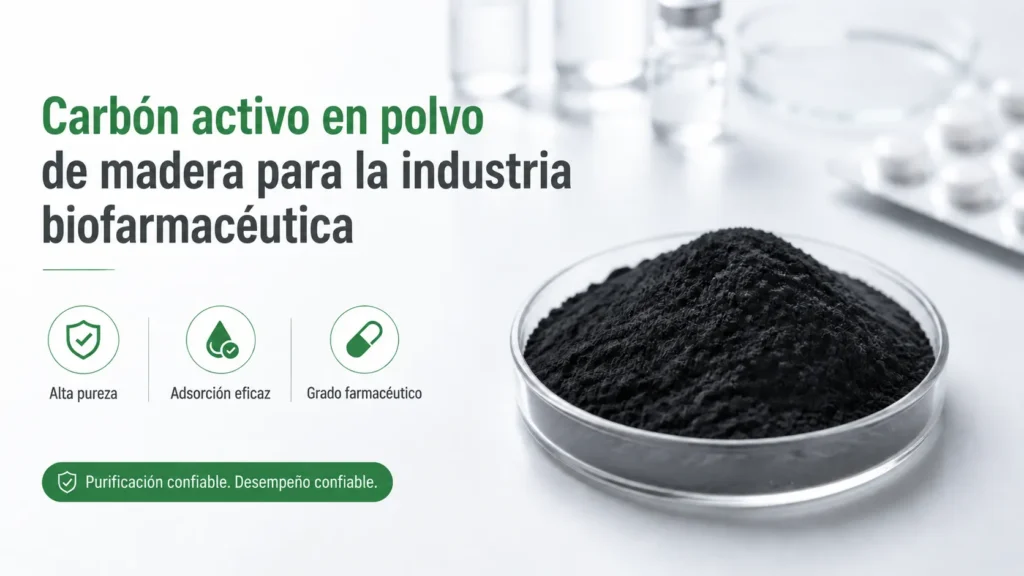
Activated carbon in wood powder is one of the most used types in the biopharmaceutical industry and has a highly developed mesoporous and macroporous structure.
Main features:
- Great fading capacity
- Effective in adsorption of high molecular weight impurities
- Good filtration properties
- Low ash content
- Suitable for adsorption in liquid phase
Main applications:
- Antibiotic decolorization
- Purification of plant extracts
- Elimination of impurities in fermentation broths
- Amino acid purification
- Vitamin production
Due to the small particle size, its adsorption rate is fast, making it very suitable for batch decolorization processes in the biopharmaceutical industry.
Granular coconut shell activated carbon
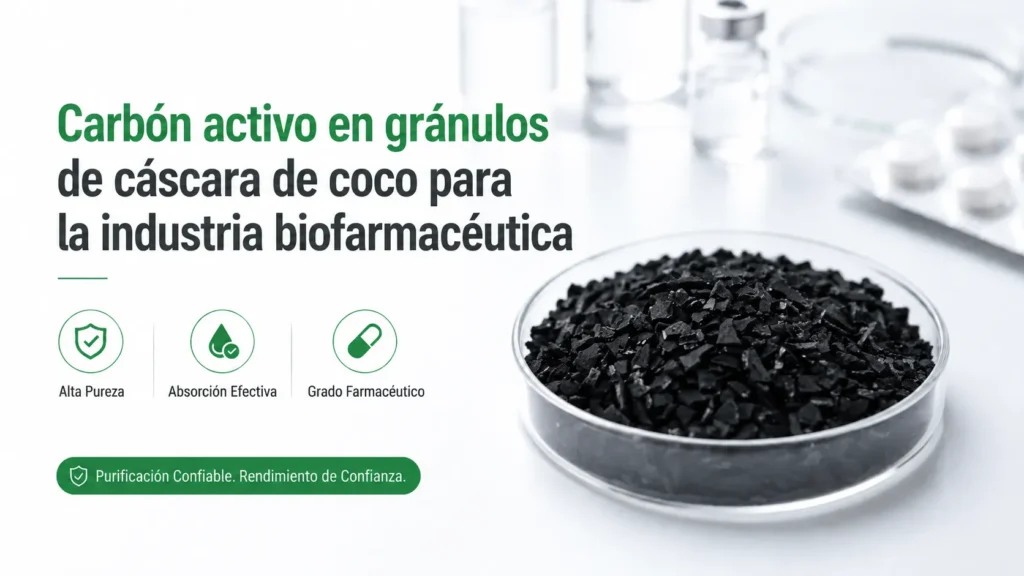
Coconut shell granular activated carbon is characterized by its high hardness, low ash content and a highly developed microporous structure, which is why it is widely used in water treatment systems for the pharmaceutical industry.
Main features:
- High mechanical strength
- Abundance of pores
- Great adsorption capacity for organic contaminants
- Long Life
- Low ash content
Main applications:
- Purified water systems
- Pretreatment of water for injection
- Reverse Osmosis (RO) Pretreatment
- Elimination of residual chlorine and odors
In pharmaceutical plants that comply with good manufacturing practices (GMP), coconut shell activated carbon is commonly used in high-quality water treatment equipment.
Conclusion
As the biopharmaceutical industry demands more and more in terms of product quality, respect for the environment and production efficiency, the use of activated carbon in this sector is becoming more widespread.
Get in contact with us without delay to choose the most suitable type and specifications of activated carbon for your pharmaceutical industry.